cartcloseinfolockmenuplayplayplayplayadd to playlistremove from playlistplaylist
Current MHT shortages My Profile Resource Hub Find a Practitioner Become a Member
1 / 1 | % |
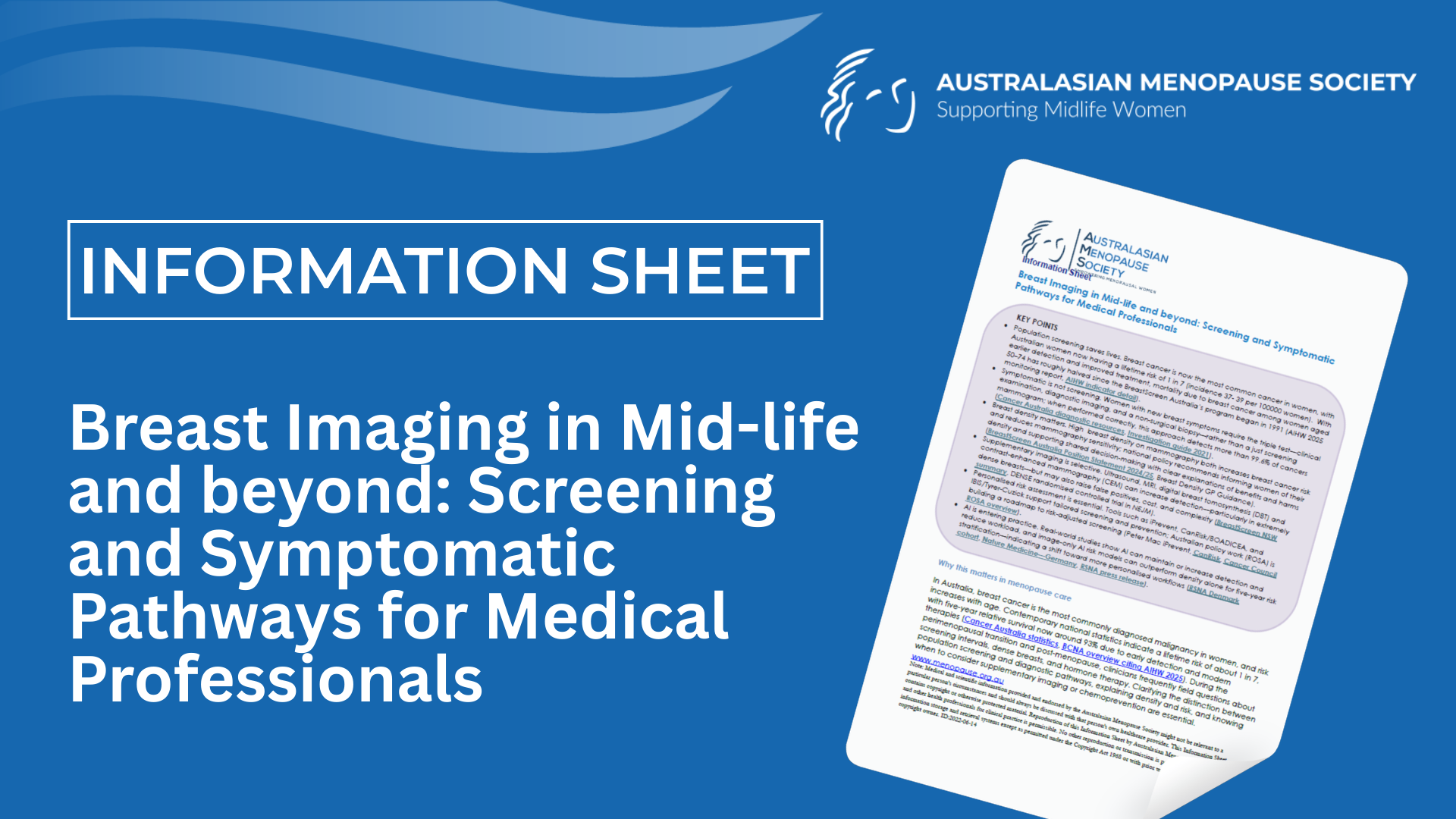
Breast Imaging in Mid-life and beyond: Screening and Symptomatic Pathways for Medical Professionals

Access to this information sheet is reserved for members.  Log in to view or  Join Here for instant access to member-only resources.  


Key Points

  • Population screening saves lives. Breast cancer is now the most common cancer in women, with Australian women now having a lifetime risk of 1 in 7 (incidence 37- 39 per 100000 women). With earlier detection and improved treatment, mortality due to breast cancer among women aged 50–74 has roughly halved since the BreastScreen Australia’s program began in 1991 (AIHW 2025 monitoring report, AIHW indicator detail).
  • Symptomatic is not screening. Women with new breast symptoms require the triple test—clinical examination, diagnostic imaging, and a non-surgical biopsy—rather than a just screening mammogram; when performed correctly, this approach detects more than 99.6% of cancers (Cancer Australia diagnostic resources, Investigation guide 2021).
  • Breast density matters. High breast density on mammography both increases breast cancer risk and reduces mammography sensitivity; national policy recommends informing women of their density and supporting shared decision-making with clear explanations of benefits and harms (BreastScreen Australia Position Statement 2024/25, Breast Density GP Guidance).
  • Supplementary imaging is selective. Ultrasound, MRI, digital breast tomosynthesis (DBT) and contrast-enhanced mammography (CEM) can increase detection—particularly in extremely dense breasts—but may also raise false positives, cost, and complexity (BreastScreen NSW summary, DENSE randomised controlled trial in NEJM).
  • Personalised risk assessment is essential. Tools such as iPrevent, CanRisk/BOADICEA, and IBIS/Tyrer-Cuzick support tailored screening and prevention; Australian policy work (ROSA) is building a roadmap to risk-adjusted screening (Peter Mac iPrevent, CanRisk, Cancer Council ROSA overview).
  • AI is entering practice. Real-world studies show AI can maintain or increase detection and reduce workload, and image-only AI risk models can outperform density alone for five-year risk stratification—indicating a shift toward more personalised workflows (RSNA Denmark cohort, Nature Medicine—Germany, RSNA press release).
Dr Emmeline Lee Brown

Emmeline Lee is a graduate of the University of Western Australia who specialised in Radiology in the West Australian Inter-Hospital training program. After completion of her fellowship exams, she undertook subspecialist training in Women’s Imaging and in Breast Imaging. She has had over 20 years experience as an Obstetric and Gynaecological Ultrasound subspecialist and currently works in both Western Ultrasound for Women, as well as in the public sector. Emmeline provides great expertise in invasive procedures in Obstetrics (including Amniocentesis and Chorionic Villus Sampling) and Gynaecology (including Saline Infusion Sonograms and HyCoSy’s to assess tubal patency). She was the first radiologist to offer Lipiodol flushing under ultrasound guidance for the treatment of unexplained fertility in Australia. She is an enthusiastic teacher of Radiology trainees and sonographers, and was the recipient of the Professor Turab Chakera Award for Radiology Teaching in 2014. She was also a finalist in the WA Clinical Supervision Awards in 2013. In 2019, Emmeline was awarded the highly prized Australian Sonologist of the Year by Australian Society of Ultrasound in Medicine.